Although China has long been associated with the martial arts, sport in China today consists of a variety of competitive sports played in China, including mainland China, Hong Kong and Macau. Traditional Chinese culture regards physical fitness as an important aspect, and, since the 20th century, a large number of sports activities, both Western and traditionally Chinese, are popular in China. The country has its own national quadrennial multi-sport event similar to the Olympic Games, the National Games of the People’s Republic of China.
Badminton, football, basketball and ping pong are the main sports in China. Prior to the 1990s, sport in China, as in some other countries, was completely government-funded. Some top athletes had quit at the height of their careers because they were uncertain about life post retirement. The situation began to change in 1994 when Chinese football became the first sport to take the professionalization road and…
Bruce Lee was originally born in San Francisco but grew up in his parents’ hometown of Hong Kong where he played parts in upwards of 20 Chinese movies thanks to his father’s influence as a Cantonese opera performer. Lee moved back to the United States when he was 18 to further his education. At this time he began to instruct Americans in the martial arts. His teaching led him to co-star in the T.V. series The Green Hornet at which time he developed his own branch of martial arts called Jeet Kune Do. Jeet Kune Do was a less disciplined type of martial arts that encouraged personal style as opposed to the strict style of other martial arts forms.
After the state’s side failure of The Green Hornet (only airing for one season) Lee moved back to Hong Kong to star in Chinese films where his series was a hit and informally known as “The Kato Show”. In China he starred in films such as The Big Boss and Fist of Fury. As the movies boomed in China, America was still reluctant to accept the Chinese culture. That was until Chuck Norris was featured as Lee’s adversary in the final fight scene of Way of the Dragon. This started America’s infatuation with not only martial arts movies but also martial arts as a whole. Lee would star in two other movies before his young death in 1973, Game of Death and Enter the Dragon.Enter the Dragon once again starred an American icon in NBA star Kareem Abdul-Jabar. It wasn’t until his death that Lee became fully recognized for his contributions to the American film industry his ability to become America’s pioneer Chinese-American in the film industry and paving the way for more Chinese-Americans to come.
Jackie Chan was born in Hong Kong, China in 1954. He failed his first year of primary school and his parents withdrew him. Shortly thereafter his family moved to Australia where his dad became the cook for the American Embassy. Jackie was sent to the China Drama Academy where he found his true love in acting and being a star. Like the Chinese stars before him, he excelled in martial arts and acrobatics. He received his breakthrough when a Hong Kong film industry boss was attracted to his stunt work ability. In 1988, Jackie Chan got his breakthrough in American films in the movie Dragons Forever. In 1998, Jackie Chan starred in his first blockbuster hit, Rush Hour, with Chris Tucker grossing more than $130 million in the U.S. alone. This movie turned into a trilogy. Jackie Chan will go down in history as arguably the most famous Chinese actor ever.
Taoism came about around the same time as Confucianism and Legalism (5th Century B.C.E. – 1st Century A.D.). There are many sects and divisions within Taoism, but they all share a few major themes. The ultimate goal is harmony within yourself and the world around you. “Tao” literally translated means “The Way” and it cannot be described in words. Wu Wei is a key term in Taoism that literally means “without action” but translates to “action through inaction.” An example of this would be a muddy puddle, do nothing and it becomes clear. the Yin Yang is a prolific symbol in Taoism signifying the balance and harmony in all things.
The Korean Flag is an example of how Taoism permeates Eastern Culture. The center of the flag is a yin yang symbol that represents the opposites of the world which cannot exist without the eachother. The red represents the Yang and is considered bright and hot, while the blue represents the Yin and is dark and cold. The symbols on the outside are called “Trigrams” taken from the I Ching. They are cyclical representations of ideas with many meanings attached to each trigram. The unbroken lines represent the Yang while the broken lines represent Yin. They are positioned on the flag to offset each other and provide a sense of harmony and balance. they represent Heaven, Earth, Fire and Water.
Ancient stone carvings, pottery, and early written works can track the ancestry of today’s extravagant acts. The Chinese Acrobats is one of the oldest performing arts. Even Confucius’s father was an acrobat. It was during the Han Dynasty (206BCE-220CE), more than two thousand years ago, that the Chinese saw the first acrobats. Acrobatics that had astonishing skill of strength and impossible balance, developed out of a village that had harvest celebrations yearly. Chinese farmers and village craftsmen, with little to do over the long winter decided to spend their time improving their public place by becoming acrobats. They trained the art form with just about anything they could find around the house and farm…cups, saucers, tables, chairs, plates…Even their own bodies, with which they formed human walls and pyramids. Every year in the fall the village’s peasants would join in the village to share in a celebration of an abundant harvest…a sort of Chinese Thanksgiving. It was at this time that the common people would show off their skills by performing fun and exciting acts of daring and strength using household tools and common items found around the farm and workshop. Building on the traditional pieces, today’s artists have added new methods and impressive stunts exciting audiences around the world. Children learned skills from their fathers and grandfathers before they were of school age. The custom of Chinese acrobatics has been passed down from generation to generation to become the act of strength, balance and grace. Much like here in America, last names are passed down. The acrobatic families of China would amuse the city rulers and the village people at formal carnivals and public theaters. Skill of “Qi Gong” or “spirits from air,” is a semi-religious study of the form of breathing and movement is very important to acrobatics. Qi Gong teaches one to use the mind and body together in perfect harmony with each other. All early acrobats were well established in the tradition of Qi Gong.
An acrobatic art institution cost about 5,000 US dollars a year which is about $600 a month. Chinese acrobats start at the age of 6 or 7. During this time they spend hours and hours perfecting basic skills such as handsprings, somersaults, handstands, and the other such skills using the flexibility of their waist and legs. The children practice 5 to 6 days a week and for many long hours. The training involves very repetitive movements and until they master the “basic skill.” At the age of 13 a child reaches the point where they can become a professional acrobat if chosen. Once entering the profession practices continue to be 5 to 6 days a week from early morning until late evening for 3 to 4 years before taking the stage. Once an acrobat has entered the profession, even as young as 13, they travel without their parents and spend a majority of the year away from home. The training for this is very long and intense. Many injuries occur during this time and the acrobats take on a whole new risk while on stage. Many parents in China have been unwilling to send their only child to an acrobatic troupe because of the difficult training.
Chinese Acrobatic Specialties:
The chinese acrobatic theatre is comprised of many specialties such as cycling, hoop diving and magic . The cycling acts are performed on stationary bicycles and used in balancing acts. A example of this is the finale called the “peacock” it is where a large group of performers on one bike position themselves like a bird unveiling its feathers. Hoop diving is another highlight of Chinese Acrobatics. It is also called “Swallow Play” because the acrobats are acting like swallows as they try to jump through group of slender hoops piled up in a pile. Another aspect of Chinese Acrobatic performance is magicians performing magic acts. Chinese magicians wear long robes and make bowls filled with water and live fish appear. They will also catch live fish in the air. Some of these specialties can be found in the performances. Such as The Lion Dance which is the most recognized performance because it originated from China. The dance involves either one or two acrobats who are under the costume of a lion. The dance symbolizes the lions strength and agility as well as its quiet and playful side. However there are audience members who do not understand the subtle gist of Chinese culture. In the People’s Republic of China the government made the policy defined as “Let a hundred flowers blossom and weed through the old and bring forth the new.” This was in 1949 which revived the old acrobatic theater and gave birth to acrobatic troupes in each province and major cities. The theater today in China has influenced many western attractions such as Cirque du Soleil and Ringling Bros. and Barnum & Bailey. In both attractions their ideas and talents were used in the performances which brought a cultural and exotic element to the shows.
Feng Shui was said to originate some 2000-5000 years ago. It is founded on a multitude of arts including astronomy, astrology, architecture, Confucianism, and many others. Feng Shui became popular in the West Han dynasty around the third century BCE. The central beliefs of feng shui revolve around energies created based on the layout of an area and its surroundings. Practitioners of feng shui believe that these energies control the flow of life. In the image above we can see some of the energies created. For example we see that the color red refers to the direction “rear middle” or south and the element fire. The energy created by the fire element will bring about fame and reputation. In contrast the wood element concentrates on health and family and is designated by the east. Feng Shui was used in the construction of gardens, temples, and homes to enhance harmonious relationships.
Practitioners of feng shui use arrangement and alignment of objects to create meaningful and useful energies. This concept may be foreign to Christians. Christians focus on God for positive energy in life and the use of feng shui would probably not mesh well with Christian culture.
The most common use for feng shui today is within the realm of interior decorating. Interior decorators now use feng shui in an effort to help their clients attain wealth, love, health, and happiness through the arrangement of furniture and colors. As we see in the picture above there are a lot of whites and grays in the layout of the room. We can see a heavy metal contrast in the room which if we refer to above brings about synchronicity and joy. If we focus on the bed we can see that it is in the center of the room and in earth tones. A clear earth element energy should be felt there, especially energies of receptivity and stillness.
The image above gives a small taste of what feng shui culture is like. I feel though that in most middle class American culture we are satisfied with just a clean bedroom. Feng Shui could possibly serve as a great organizational tool for some of us though.
The elements above are often seen to refer to match making similar to the western zodiac and in healing concepts. In matchmaking the concepts of feng shui in combination with the Chinese zodiac are used to seek compatibility. For example the rabbit is a wood element zodiac object. The rabbit is most compatible with those in an adjacent cycle most notably the ox, the snake, and the goat. These objects are water, fire, and fire elements respectively. The rabbit should avoid the other wood elements such as the dragon.
Likewise in ancient Chinese medicine similar theories were used to diagnose and treat illness. A correspondence system was created based on this to make for easy diagnosis and treatment. The wood element referred to the liver, fire to the heart, earth to the spleen, metal to the lungs, and water to the kidneys.
Varying opinions are seen on these topics. Very stable relationships have been made on this basis as have medical treatments. Is this a coincidence or is there some truth to the cyclical behavior of the elements of feng shui?
Kung Fu is a broad term that is used to describe all martial arts of Chinese origin. Kung Fu was called Ch’uan Fa also known as (fist way). The genesis of Chinese martial arts has been attributed to the need for self-defense, hunting techniques and military training in ancientChina. Hand-to-hand combat and weapons practice were important in training ancient Chinese soldiers. According to legend, Chinese martial arts originated during the semi-mythical Xia Dynasty, more than 4,000 years ago. It is said that the Yellow Emperor Huangdi introduced the earliest fighting systems to China. The Yellow Emperor is described as a famous general who, before becoming China’s leader, wrote lengthy treatises on medicine, astrology and the martial arts.
The Shaolin Monastery (Temple).
The Shaolin monastery housed many fugitives from justice, and many warriors turned monk, which sets the roots of Kung Fu in the Shaolin Temple in Northern China. In fact there were five different Shaolin temples in five districts, and so five distinct styles of Shaolin Kung Fu developed. Martial arts historians stress that Kung Fu did not start at the Shaolin temple, but simply began to flourish under Shaolin’s influence. Kung Fu became eventually categorized into Northern and Southern styles. The Shaolin style of wushu is regarded as amongst the first institutionalized Chinese martial arts. The oldest evidence of Shaolin participation in combat is a stele from 728 CE that attests to two occasions: a defense of the Shaolin Monastery from bandits around 610 CE, and their subsequent role in the defeat of Wang Shichong at the Battle ofHulao in 621 CE. From the 8th to the 15th centuries, there are no extant documents that provide evidence of Shaolin participation in combat. Between the 16th and 17th centuries, no fewer than forty sources exist to provide evidence both that monks of Shaolin practiced martial arts, and that martial practice became an integral element of Shaolin monastic life.
Training
Chinese martial arts training consists of the following components: basics, forms, applications and weapons. Different styles place varying emphasis on each component. In addition, philosophy, ethics and even medical practice are highly regarded by most Chinese martial arts.
Basics
The Basics are a vital part of any martial training. Basics are usually made up of rudimentary techniques, conditioning exercises, including stances. Basic training may involve simple movements that are performed repeatedly. Stances are structural postures employed in Chinese martial arts training. They represent the foundation and the form of a fighter’s base. Each style has different names and variations for each stance. Stances may be differentiated by foot position, weight distribution and body alignment. The goal of is to maintain the structure of the stance through a set time period, or dynamics. The horse-riding stance and the bow stance are examples of stances found in many styles of Chinese martial arts. In many Chinese martial arts, meditation is considered to be an important component of basic training.
Mediation
Meditation can be used to develop focus, mental clarity and can act as a basis for qigong training.
Forms
Forms are series of predetermined movements combined so they can be practiced as one linear set of movements. Forms were originally intended to preserve the lineage of a particular style branch, and were often taught to advanced students who were selected to preserve the art’s lineage. Forms were designed to contain literal, representative and exercise-oriented forms of applicable techniques, which would be extracted, tested and trained by students through sparring sessions.
Today, many consider forms to be one of the most important practices in Chinese martial arts. Traditionally, they played a smaller role in training combat application, and were eclipsed by sparring, drilling and conditioning. Forms gradually build up a practitioner’s flexibility, internal and external strength, speed and stamina, and teach balance and coordination. Many styles contain forms using a wide range of weapons of various length and type, utilizing one or two hands. There are also styles, which focus on a certain type of weapon. Forms are meant to be practical, usable, and applicable as well as promoting flow, meditation, flexibility, balance and coordination.
There are two general types of forms in Chinese martial arts. Most common are “solo forms” which are performed by a single student. There are also “sparring” forms, which are choreographed fighting sets performed by two or more people. Sparring forms were designed both to acquaint beginning fighters with basic measures and concepts of combat, and to serve as performance pieces for the school. Sparring forms, which utilize weapons, are especially useful for teaching students the extension, range and technique required to manage a weapon.
Application
Application refers to the practical use of combative techniques. Chinese martial arts techniques are ideally based on efficiency and effectiveness. Application includes non-compliant drills, such as pushing hands in many internal martial arts, and sparring, which occurs within a variety of contact levels and rule sets.
Weapons Training
Most Chinese styles also make use of training in the broad arsenal of Chinese weapons for conditioning the body as well as coordination and strategy drills. Weapons training are generally carried out after the student is proficient in the basics, forms and applications training. The basic theory for weapons training is to consider the weapon as an extension of the body. It has the same requirements for footwork and body coordination as the basics. The process of weapon training proceeds with forms, forms with partners and then applications.
Similarities Between American Martial Arts and Chinese Martial Arts
They both go through the same process of training such as Mediation and stance.
They both hold competitions and tournaments, but are not Olympic events.
Differences Between American Martial Arts and Chinese Martial Arts.
Kung Fu has circular movements and has complex techniques whereas Karate has streamlined movements that appear to be simpler.
Kung Fu is considered a soft style whereas Karate is a hard style of martial art.
Teachings in the Kung Fu is extremely more deadly compare to Karate.
The first thing we think about as Americans going to a Chinese restaurant is fortune cookies, but what we don’t know is that the fortune cookie was a just a form of entertainment for the meal made up by Americans.
An original Chinese dish :This is Zong Zi or dumplings. It is traditionally served around the time of the dumpling festival or the dragon boat festival Duan Yu Jie. The dumplings are then eaten in memory of Qu Yuan, who was a poet from the Kingdom of Chu who committed suicide at the invasion of his country by the Qin armies. They are made with rice and wrapped in bamboo leaves. Then tied with a string and boiled or steamed. Inside the shell is usually something sweet that people in the surrounding area like to eat. Also they usually included Chinese tea to help with digestion.
A more westernized Chinese dish: General Sto is a sweet and spicy deep fryed chicken. It is very popular in American Chinese restaurants. The dish was named after Zou Zongtang a Qing dynasty general, but the dish was reportedly made in New York around 1970.The dish was first mentioned in the New York Times in 1977. Although it may have been made by a Chinese chief it was influenced by American culture.
Comparison of dishes: The Chinese dish is more healthy for you. It even has Chinese tea to help with digestion. While the American dish is deep-fried in fat and served with artery blocking sweet hot sauce. The Chinese dish has a meaning to it being the main food of a festival. While the American dish is just something that was made to make Americans want to come into the restaurant.
History of human habitation on the Hainan Island can be traced back from as late as 200 BC. According to ancient records, the island was nicknamed the “Tail of the Dragon” and was known as the last unexplored frontier of China and civilization. Because of its remote and forbidding location, many traitors were exiled to this island. In 1890, the Hainan Island was used as a strategic military outpost to combat the French in the Qing Dynast. By August 1987, the State Council made a proposal to establish Hainan as a province. In 1988, Hainan Island became China’s 30th province and its largest economic zone.
One difference of the history of the Hainan Province and America was that America was founded as a nation over 100 years before the Hainan Province was founded. One of the main reasons for why people moved to America was for the new land and resources that were thriving in an untouched territory. Similarly to America, the Hainan Province was established as a Province for its many natural resources.
Natural Resources
The capital of this island is Haikou. With the climate set a an average of 75 degrees, it’s no wonder that as of 2010 the population was estimated at 8,671,518 people. This slice of Heaven is also able to produce lush farmlands all year round. One of their main out sources comes from the Dongjiao coconut Plantation. This plantation is the home of just over 500,000 trees. another great product is salt. They are able to cultivate it and dry it out along the white sandy beaches. Not only is this an excellent agricultural location, it is the home of a healthy mineral resource as well. Many mines can be found housing titanium, cobalt, copper, gold, silver, and many others. Over all, this is the perfect mix between a home of natural resources and what we as Americans think of Hawaii. It is a tourist’s and a mainland chinese’ getaway!
Tourism
Hainan has become a popular destination for tourists. There are many beaches that stretch or miles and beautiful waters. The oceans carry various species of fish and many of the cities are “glorified fishing village[s].” Also, the Red Forest Nature Reserve is an evergreen forest. One of the top things to see at this park is when the tide is high, the trees roots are submerged in water so that it seems as though the trees are growing out of the sea. During this time, the roots carry a high abundance of fish and shrimp. The forest, despite the name, does not have red leaves. the leaves on the trees here are also said to have medicinal value. Hainan Tropical Wildlife Park and Botanical Garden is home to more than 4000 rare birds and has more than 200 species. There is also a variety of plants including rare species and a tropical fruit forest. Monkey Island, home to the Macaque monkeys, is one of the popular tourists’ attractions where people can go and actually interact with the animals. Haikou is the capital city of Hainan and is the entering point to all of the island’s tourists. Sanya is the second largest city to Hainan and is the most popular attraction to visitors because of its resorts and beaches. The Hainan islands are very similar to the Hawaiian Islands and the temperature rarely drops below 65 degrees Fahrenheit, even during the winter. Other than the various parks and oceans, Hainan, like many other places, offers hiking, snorkeling, and golfing. Tourism is very similar to that of the United States. Hainan’s climate is very tropical and the temperature ranges from 65-82 degrees Fahrenheit. On average, there are 300 days of sunshine. However, between the months of July and September, at least one typhoon is typical.
One of the top things to see at this park is when the tide is high, the trees roots are submerged in water so that it seems as though the trees are growing out of the sea. During this time, the roots carry a high abundance of fish and shrimp. The forest, despite the name, does not have red leaves. the leaves on the trees here are also said to have medicinal value.
Image of the Guanyin statue (also known as the Goddess of mercy); Sourced from www.sitenet.com
Religion
Protestant missionaries began arriving in 1881. Muslim and Buddhism have dominated the island since it was founded centuries ago. Atheism listed as official religion. Other major religions are Buddhism, Muslim, Daoism, and Christianity. Christianity is small, but is growing at a fast rate. Daoism worship is in Wenbefing Mountain and Wenbefing Daoism Park at the Yuchan Palace. Buddhism has a famous center of worship in the southernmost part of the island at Shaolin. Muslim worship most commonly takes places in Hui-Hui village mosques. Christianity has churches scattered all over the island. Buddhism and Muslim are the majority because of Chinese tradition. Christianity is growing due to church planting and missionaries. Buddhism has the most worshippers on the island with 90,000 people, Muslim has about 70,000 worshippers, and Christianity has about 40,000 protestant and 4,000 catholic worshippers.
One similarity that the Hainan Province religions have in common with American religions is that fact that the Muslim faith is also the second largest religion in America. One difference between Hainan Province religions and American religions is the fact that Christianity is the most popular religion in America, but in the Hainan province it is behind Daoism, Buddhism, and Muslim. This region of China has pretty segmented areas of religion (Muslim North, Buddhist South). Looking at this information from a biblical perspective it is apparent that Christians need to remain passionate about reaching the East for the cause of Christ.
Brief History: The first Olympic games were held in 776 BC in Greece and in 339 AD, Roman emperor Theodosius the Great prohibited the Olympic games as a pagan activity. The People’s Republic of China competed in the Olympic Games for the first time in 1952. In 2008 a total of 11,028 athletes competed in 28 sports and 302 events. China became the 22nd nation to host them.
The Beijing National Stadium also known as the Bird’s Nest was designed for the 2008 Summer Olympics. It was the main track and field stadium for the 2008 Summer Olympics and host to the opening and closing ceremonies. The Stadium cost $423 million. The Bird’s nest design actually came from the study of Chinese ceramics made up of steel beams, which helps support the retractable roof. Ground breaking day was on December 24, 2003 and officially opened on June 28, 2008.
The Beijing National Stadium can seat as many as 100,000 spectators. This stadium has replaced the original venue of the Guangdong Olympic Stadium. It is 250,000 square meters. It was the main track and field stadium for the 2008 Summer Olympics and host to the Opening and Closing ceremonies. After the Olympics the stadium continued to host international sporting events such as football and other sports. They recently used it for a snow theme park.
The owners plan for the stadium to anchor a shopping and entertainment complex and are being developed now. The stadium now can function as a tourism attraction while still searching for sports and entertainment events. Off season still brings around 20,000 – 30,000 people a day at the price of 50 yuan for admission. It cost around $9 million to keep it up every year.
Summer Games:
Since 1979 Chinese athletes have taken part in seven Olympic Summer Games, taking a total of 163 golds, 117 silvers and 106 bronzes and making valuable contributions to the global Olympic Movement. Through the Games Chinese athletes have won medals, friends and experience and displayed China’s strength to the rest of the world. In China’s first full-scale participation in the Olympics in 1984, sharpshooter Xu Haifeng won China’s first Olympic gold medal, which was described as “a break through zero.”
Luke 6:48 – He is like a man building a house, who dug down deep and laid the foundation on rock. When a flood came, the torrent struck that house but could not shake it, because it was well built.
What other advantages can the Beijing National Stadium bring to the table?
(Medals of Beijing Olympic Games sourced from en.beijing2008.cn)
The Summer Olympics
The People’s Republic of china first participated in the summer olympics in 1952 at the summer games in Helsinki, Finland. Although, China competed in the 1932 olympics, they did this under the name The Republic of china . Unfortunately, China was not able to participate in the olympics games held between 1956 – 1980 due to various conflicts over the politacal status of China. In 1984, China rejoined the Summer Olympic movement and won their first gold medal that same year. The Gold medal was awarded to Xu Haifeng in the 50m pistol event. This achivement was later called “a break through Zero” because it was an event that brought great joy to the chinese people. Since then, the People’s Republic of china has participated in every summer olympic event and has won hundreds of medals. The table below show the medals won by china in the years they participated and this data was compared to those won by United States in the same year.
What was responsible for the sudden increase in amount of Gold medals won at the turn of the millenium?
In 1989, China began to experience an economic growth under the third generation leadership governed by Jiang Zenim. During this period, China experienced an economic growth averaging about 8% each year and in the year 2005, the private sector GDP rose to about 50%.
In the late 1990’s, two colonies were returned back to china. In 1997 Hong Kong from Britain and in 1999 Macau from Portugal.
Another reason could be because of the Sino-Russian Treaty of Friendship signed in 2001. This treaty hopes to encourage peace between china and russian by providing mutual assistance in various areas which include the military, economy, energy, etc. The treaty is also a step taken to balance U.S dominance in the world.
Chinese Paralympics
China has competed in the summer Paralympics since the 1984 games in New York where they won 22 total medals with only two gold. When they hosted the games in 2008 at Beijing they finished ranked first with 211 medals and 89 gold. There are 20 competitions in the Paralympics ranging from archery to wheelchair basketball. China is considered the world’s top Paralympic nation after making rapid progress in disability sport in recent years. In the past, Their sense of national pride means that a huge effort is being put in to ensure China are the top nation in their home Games. As well as the intensive training regimes, more and more athletes are being brought to overseas competitions to test themselves against competitors from other nations.
Presentation by Dominique Hannah and Kelsey Barnes.
Softball originated in the US in 1887 where the first game was played on Thanksgiving Day and nearly 100 years later, China developed the sport. Softball began in China in 1979 in Beijing. In 1986 the Chinese Softball Association (CSA), a non-profit organization began and was headquartered in Beijing. The association is a member of the All-China Sports Federation. The major tasks of the association are to host and organize national and international competitions, provide training programs, select and recommend players and coaches for the national team, and organize training for the national team.
In 2006 softball was played in about 52 primary and middle schools in China. This is really important because it is developing young athletes and continuously increasing the number of girls playing the game. There are more similarities than differences when it comes to comparing softball in China and the…


 The first thing we think about as Americans going to a Chinese restaurant is fortune cookies, but what we don’t know is that the fortune cookie was a just a form of entertainment for the meal made up by Americans.
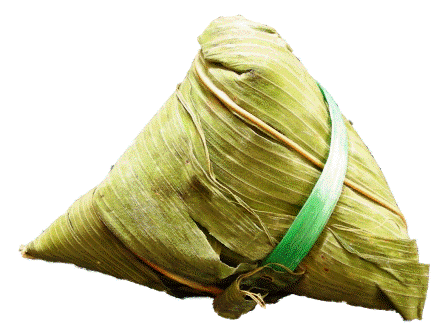 An original Chinese dish :This is Zong Zi or dumplings. It is traditionally served around the time of the dumpling festival or the dragon boat festival Duan Yu Jie. The dumplings are then eaten in memory of Qu Yuan, who was a poet from the Kingdom of Chu who committed suicide at the invasion of his country by the Qin armies. They are made with rice and wrapped in bamboo leaves. Then tied with a string and boiled or steamed. Inside the shell is usually something sweet that people in the surrounding area like to eat. Also they usually included Chinese tea to help with digestion.
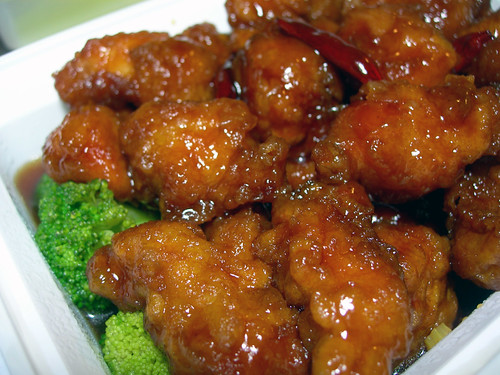 A more westernized Chinese dish: General Sto is a sweet and spicy deep fryed chicken. It is very popular in American Chinese restaurants. The dish was named after Zou Zongtang a Qing dynasty general, but the dish was reportedly made in New York around 1970.The dish was first mentioned in the New York Times in 1977. Although it may have been made by a Chinese chief it was influenced by American culture.


